
Free Employer Aggregate Rating Schema Markup Generator (JSON-LD)
When a job seeker searches for a company name on Google, one of the first things they want to know is: what do employees actually think of working there?
That question — asked millions of times every day — is exactly what Employer Aggregate Rating schema markup is designed to answer in search results. If your website publishes employee ratings and reviews about hiring organisations, this structured data type is one of the most valuable SEO opportunities available to you right now. It puts your employer ratings directly in front of job seekers at the moment they’re evaluating a company — before they’ve even clicked a result.
This free Employer Aggregate Rating Schema Markup Generator creates valid, Google-compliant EmployerAggregateRating JSON-LD for your employer review pages in seconds. Enter your rating data, generate the structured code, paste it into your page. No developer required. No plugin configuration. Just clean, accurate structured data built from the official Schema.org and Google Search Central specifications.
If your site is a job board, a career platform, an employer review site, an HR technology product, or any website that aggregates employee sentiment data about hiring companies — this tool was built for you.
How To Use This Tool
Fill in the company information being reviewed:
- Organization Name: The company being rated
- Organization URL: Company website or profile page
- SameAs URL: Alternative profile or reference link
Configure the aggregate rating metrics:
- Rating Value: The current average rating score
- Best Rating: The highest possible score
- Worst Rating: The lowest possible score
- Rating Count: Total number of ratings submitted
Once generated:
- Copy Code: Copy the JSON-LD to your webpage
- Download JSON/PDF: Export for documentation
- Validate: Test with Schema.org validator
Use Case: Employer review sites, company rating platforms, workplace satisfaction surveys.
Generated Schema
What Is Employer Aggregate Rating Schema Markup?
EmployerAggregateRating is a structured data type defined by Schema.org that describes an aggregated rating of an organisation specifically related to its role as an employer. It is a specialised extension of the AggregateRating type — inheriting its core rating properties — but scoped exclusively to the employment context.
In plain terms: it tells Google that the rating on your page isn’t a product review or a customer satisfaction score. It is an evaluation of what it’s like to work for a particular company, compiled from multiple employee reviews or ratings.
The full inheritance chain for this type is Thing > Intangible > Rating > AggregateRating > EmployerAggregateRating — meaning it inherits properties from all parent types. The core required properties come from AggregateRating: itemReviewed (the organisation being rated), ratingValue (the score), and ratingCount (how many ratings contributed to the score).
Adding EmployerAggregateRating can provide job seekers with ratings about a hiring organisation to help them choose a job. It also offers prominent brand placement in the enriched job search experience on Google.
This is structured data that serves two audiences simultaneously: job seekers who need better information to make career decisions, and employers who gain brand visibility in a high-intent search context. Platforms that implement it correctly sit at the centre of that exchange, positioned as the trusted source of employer reputation data in Google’s results.
Who Should Use Employer Aggregate Rating Schema?
This schema type is specifically designed for platforms that collect, aggregate, and publish employee opinion data about hiring organisations. If your site does any of the following, this generator is the right tool for you.
Job Review Platforms — Sites that collect written employee reviews and numeric ratings about companies as employers are the primary use case for this schema. Each company profile page that displays an aggregated star rating compiled from employee submissions is a candidate for EmployerAggregateRating markup.
Job Boards with Employer Ratings — Many job boards have expanded beyond listings to include employer reputation scores collected from current and former employees. If your job board has a ratings component, this schema surfaces those ratings in Google’s enriched job search experience.
HR Technology and People Analytics Platforms — SaaS products that track employee satisfaction, engagement, or employer Net Promoter Scores (eNPS) and publish aggregated benchmarks are increasingly publishing this data publicly. Employer aggregate rating schema makes that published data discoverable in search.
Employer Branding Agencies and Career Sites — Agencies managing employer reputation programmes for clients, or career-focused publishers who compile employer data from multiple sources and present aggregate scores, can use this markup to signal data quality and drive traffic from company-specific searches.
Niche Industry Career Platforms — Specialised career communities — in healthcare, technology, finance, education, or any other sector — that collect sector-specific employer ratings benefit particularly from this schema because their rating data is more targeted and credible than general-purpose review sites.
Recruitment Agencies with Employer Intelligence — Agencies that publish employer rating data as a value-add for candidates, combining their own placement experience with aggregated feedback, can use this schema to surface that intelligence in search.
Why Employer Aggregate Rating Schema Matters for SEO and Recruitment Marketing
The stakes for employer reputation in search results have never been higher. The rise of remote work, talent scarcity, and candidate-driven markets has transformed how job seekers research companies before applying. Structured data that puts your employer ratings in Google’s enriched results taps directly into this behaviour change.
Enhanced Visibility in Google’s Job Search Experience
Google offers prominent brand placement in the enriched job search experience for sites that implement EmployerAggregateRating correctly. This means your employer rating data can appear alongside job listings in Google’s dedicated jobs search interface — the panel that surfaces when someone searches for roles at a specific company. Job seekers evaluating whether to apply see your rating data as part of their research process, directly in Google’s results.
High-Intent Branded Search Traffic
When someone searches for “[Company Name] reviews” or “[Company Name] employee ratings”, they are deep in an evaluation process. They want to know what working at that company is actually like. Sites with EmployerAggregateRating schema markup can appear in enriched results for these high-intent branded queries, capturing research traffic at exactly the moment a candidate is forming an opinion about a potential employer.
Trust and Credibility Signalling
Structured data is, at its core, a trust signal. When your employer rating page has EmployerAggregateRating schema, you’re making an explicit, machine-readable declaration to Google: this is verified aggregated data about this specific employer, compiled from this many ratings, with this score. That declaration is treated differently from unstructured text on a page — it is a formal claim that Google can process, verify against other data sources, and use to enrich its understanding of the company entity.
Transition from Review Snippet — Act Now
During the beta phase, Google recommended adding review snippet structured data for pages to be eligible for the jobs enriched search results. Google now recommends transitioning from review snippet structured data to EmployerAggregateRating structured data soon.
If your site currently uses generic ReviewSnippet or AggregateRating markup for employer ratings, this is an official Google recommendation to migrate. Continuing to use the older format is not broken, but it is no longer best practice and may become less effective as Google’s support for the dedicated employer rating type matures.
AI Search and Entity Recognition
As AI-powered search platforms build their understanding of companies and employers, structured data about employer reputation becomes an important input. When ChatGPT, Perplexity, or Google’s AI Overviews are asked about a company’s reputation as an employer, they draw on available structured and semi-structured data about that organisation. EmployerAggregateRating schema creates a clean, unambiguous data point that AI systems can process with confidence — far more reliable for AI indexing than unstructured text in a paragraph.
How to Use the Employer Aggregate Rating Schema Markup Generator
This generator covers all required and recommended properties from both Google’s specification and the full Schema.org EmployerAggregateRating type definition. Here is what each field means and how to fill it in correctly.
Step 1: Enter the Organisation Name (itemReviewed.name) This is the name of the company being reviewed as an employer — not your platform’s name. Use the organisation’s official legal or trading name exactly as it appears in official business registrations. Consistency between this name and the company’s official web presence helps Google match your rating data to the correct entity in its knowledge graph.
Step 2: Add the Organisation URL (itemReviewed.url) Enter the official website URL of the employer being reviewed. This cross-reference helps Google confirm which organisation entity your rating data refers to — particularly important for common company names that might apply to multiple organisations.
Step 3: Add Organisation sameAs Links (Recommended) Link the reviewed organisation to its authoritative profiles elsewhere — its LinkedIn Company page, its Wikidata entry, its Crunchbase profile, its Google Business Profile URL, or any other authoritative identifier. The sameAs property on the itemReviewed entity helps Google build a confident entity match and is one of the most effective ways to ensure your rating data is attributed to the correct company.
Step 4: Enter the Rating Value (ratingValue) The aggregate score for this employer. Use a decimal number value — for example, 4.2 or 3.8. Per Schema.org’s specification, use standard Unicode digit characters (0–9) and a full stop (.) as the decimal separator. Do not use commas as decimal separators.
Step 5: Set the Best and Worst Rating (bestRating, worstRating) Declare the scale your rating system uses. If you use a 5-star scale, set bestRating to 5 and worstRating to 1. If you use a 10-point scale, set them to 10 and 1 respectively. This context is critical — a ratingValue of 4 means something very different on a 5-point scale versus a 10-point scale. Google needs both endpoints to interpret the score correctly.
Step 6: Enter the Rating Count (ratingCount) The total number of individual ratings that contributed to the aggregate score. This is an integer — a whole number. Do not include decimal places. This figure should match exactly what is visibly displayed on your page.
Step 7: Add Review Count (reviewCount) — Optional If your platform distinguishes between ratings (numeric scores only) and full written reviews, enter the number of written reviews separately. This is optional but adds precision to your data — a company with 500 ratings and 180 written reviews tells a richer story to Google than just a rating count alone.
Step 8: Add a Description (Recommended) Write a short factual description of the aggregate rating in one to two sentences. For example: “TechCorp receives a 4.1 out of 5 employer rating based on 312 employee reviews covering work culture, management, and career development.” This populates the description property and provides context that Google and AI systems can use when referencing the data.
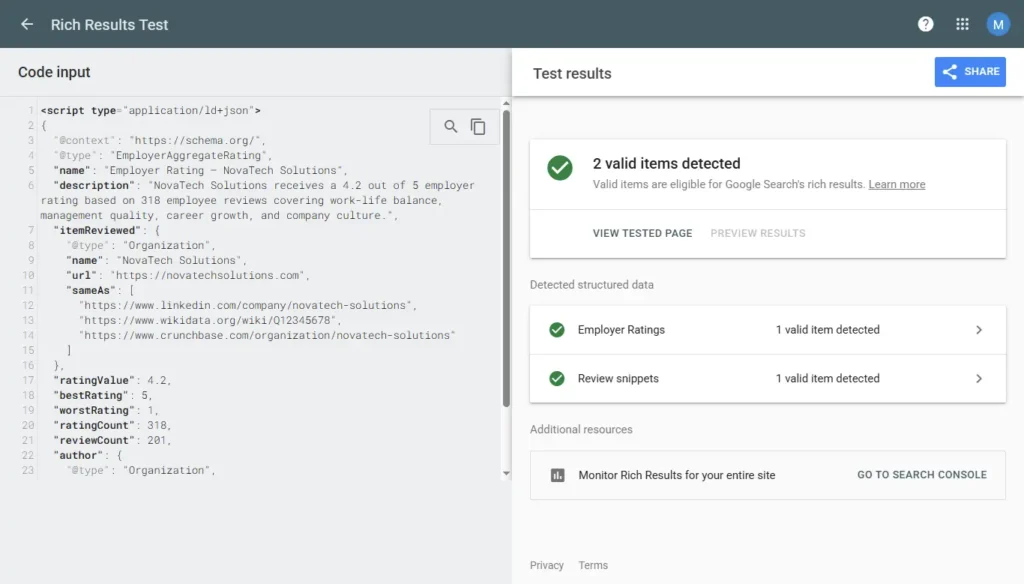
Step 9: Generate, Validate, and Implement Click Generate Schema. Copy the JSON-LD output. Paste it into Google’s Rich Results Test to confirm validity. Then add it to the <head> section of the specific employer profile or rating page on your site.
How to Add Employer Aggregate Rating Schema to Your Website
The EmployerAggregateRating JSON-LD block should be placed on the specific employer profile page or review summary page that displays the aggregated rating data — not your homepage, not a category listing, not a search results page. The rating information in your schema must correspond to content that is visibly displayed on that same page.
WordPress
Use the WPCode plugin to inject the JSON-LD on a per-page basis using custom code snippets scoped to specific page templates or post IDs. If your employer profiles are a custom post type, add the schema dynamically to the post type template using wp_head with conditional checks.
Custom Web Applications (Node.js, Python, PHP, Ruby)
Generate the JSON-LD server-side using your employer profile data from the database. Inject it into the <head> of the page template for each employer profile. Dynamically populate ratingValue, ratingCount, reviewCount, and itemReviewed.name from your rating data model to ensure the schema always reflects current data.
React / Next.js / Vue.js (JavaScript-Rendered Sites)
Use server-side rendering (SSR) or static site generation (SSG) to ensure the JSON-LD is present in the initial HTML response. In Next.js, use the <Head> component with a <script type="application/ld+json"> tag populated with your employer rating data. Avoid client-side-only injection if possible — server-rendered schema is processed more reliably by Googlebot.
Shopify, Wix, Squarespace (Website Builders)
Inject the JSON-LD via the custom code/header injection feature on the specific employer profile page. Most website builders allow per-page custom code at the page settings level.
Employer Aggregate Rating Schema Markup Example — Complete JSON-LD
Here is a complete, production-ready EmployerAggregateRating schema example — exactly the format this generator produces. This example is for a technology company employer profile on a job review platform.
					<script type="application/ld+json">
{
  "@context": "https://schema.org/",
  "@type": "EmployerAggregateRating",
  "name": "Employer Rating — NovaTech Solutions",
  "description": "NovaTech Solutions receives a 4.2 out of 5 employer rating based on 318 employee reviews covering work-life balance, management quality, career growth, and company culture.",
  "itemReviewed": {
    "@type": "Organization",
    "name": "NovaTech Solutions",
    "url": "https://novatechsolutions.com",
    "sameAs": [
      "https://www.linkedin.com/company/novatech-solutions",
      "https://www.wikidata.org/wiki/Q12345678",
      "https://www.crunchbase.com/organization/novatech-solutions"
    ]
  },
  "ratingValue": 4.2,
  "bestRating": 5,
  "worstRating": 1,
  "ratingCount": 318,
  "reviewCount": 201,
  "author": {
    "@type": "Organization",
    "name": "CareerLens",
    "url": "https://careerlens.com"
  }
}
</script>
Breaking down each property:
@type: "EmployerAggregateRating" — Declares this as a specialised employer rating, not a general product or service review. This specific type is what makes the data eligible for Google’s enriched job search results rather than general review rich results.
description — A factual one-to-two sentence summary of the rating. This is the text that AI systems and rich snippet generators use to contextualise the score. Be precise — include the scale, the number of reviews, and what aspects were rated.
itemReviewed (Organization) — The employer being rated. The name should exactly match the company’s official name. The url and sameAs links are the entity anchors — they tell Google which specific company in its knowledge graph this rating refers to. This is critically important for common or ambiguous company names.
ratingValue — The aggregate score as a decimal number. Using 4.2 rather than 4 conveys more precision and is more credible to both users and Google’s data processors.
bestRating and worstRating — The scale boundaries. Without these, Google cannot contextualise the ratingValue. A ratingValue of 4 is excellent on a 5-point scale but mediocre on a 10-point scale. Always declare both endpoints.
ratingCount — The total number of individual rating submissions. This should match the number displayed on your page exactly.
reviewCount — Optional but recommended if your platform collects written reviews separately from star ratings. Many users leave a numeric rating without a written review, so this number is often lower than ratingCount.
author — The organisation that compiled and published the rating data — your platform. This attribution is important for entity verification and helps Google understand who is making the data claim.
EmployerAggregateRating vs AggregateRating vs ReviewSnippet — What's the Difference?
Understanding the distinction between these three related structured data types is essential for implementing the right one for your use case.
AggregateRating is the general-purpose parent type for any aggregated rating — products, services, books, movies, businesses, or anything else. It is the most commonly used rating schema type and is supported across many rich result formats. If your site rates something that isn’t specifically an employer, AggregateRating is the right type.
EmployerAggregateRating is a direct subtype of AggregateRating specifically scoped to the employment context — ratings of organisations as places to work. It inherits all AggregateRating properties but signals to Google that this particular rating is about employer quality, not product or service quality. This distinction is what makes it eligible for the jobs enriched search experience rather than general shopping or review rich results.
ReviewSnippet (using AggregateRating on a page with individual Review objects) was the previous recommended approach for employer ratings during Google’s beta phase of the jobs enriched experience. As noted in Google’s current documentation, the recommendation is now to transition to dedicated EmployerAggregateRating markup. The older approach still works but is no longer aligned with Google’s recommended implementation.
The practical rule: if you’re rating a company as an employer and you want your data to appear in Google’s jobs-related rich results, use EmployerAggregateRating. For all other types of aggregated ratings, use the standard AggregateRating type.
Google's Content and Technical Guidelines for Employer Ratings
Meeting the markup requirements is only part of the picture. Google applies specific content quality standards to employer rating data that determine whether your pages qualify for enriched results.
Content Must Be User-Generated
EmployerAggregateRating is designed for platforms that publish user-generated ratings — scores and reviews submitted by actual employees or former employees of the rated organisation. It is not intended for editorially assigned ratings, paid placement scores, or platform-generated assessments without user contribution. Your page must display real, user-submitted rating data.
Ratings Must Be Visible on the Page
The aggregated rating displayed in your schema must match what is visibly shown on the page. If your schema declares a ratingValue of 4.2 and ratingCount of 318, that information must be readable by a user visiting the page. Schema data that doesn’t correspond to on-page content is considered misleading and violates Google’s general structured data guidelines.
The itemReviewed Must Be a Hiring Organisation
The entity in the itemReviewed field must be an organisation in its role as an employer — a company that hires people. Do not use this schema type to rate individuals, specific job roles, or non-employer entities. The @type of itemReviewed should be Organization.
Accuracy and Integrity of Rating Data
While Google doesn’t validate the individual reviews behind your aggregate score, it does expect that your rating methodology is transparent and that your aggregate figure is a genuine mathematical average of real user submissions. Fabricated, manipulated, or selectively curated aggregate scores that don’t reflect actual user sentiment violate Google’s spam policies for structured data.
One EmployerAggregateRating Per Employer Page
Each employer profile page should have one EmployerAggregateRating block that represents the aggregate score for that employer. Do not add multiple EmployerAggregateRating blocks to the same page, and do not add this schema type to pages that don’t display employer-specific rating data.
Common Employer Aggregate Rating Schema Mistakes to Avoid
Mistake 1: Omitting bestRating and worstRating This is the most common implementation error. Without the scale boundaries, Google cannot interpret your ratingValue correctly. A 4.2 score is meaningless without knowing it’s on a 5-point scale. Always declare both. Google’s validator will accept schema without them, but the output will not be correctly contextualised in rich results.
Mistake 2: Rating Count Doesn’t Match the Page If your schema says ratingCount: 318 but your page displays “124 reviews”, that discrepancy flags your markup as potentially inaccurate. Google compares declared schema data against on-page content. Keep them synchronised — ideally by generating your schema dynamically from the same data source that populates your on-page display.
Mistake 3: Using AggregateRating Instead of EmployerAggregateRating Both will pass validation, but only EmployerAggregateRating is eligible for the jobs enriched search experience. If you’ve been using generic AggregateRating for your employer ratings, switching to the dedicated type is a meaningful implementation improvement.
Mistake 4: Not Identifying the itemReviewed Precisely If your itemReviewed only contains a name with no URL or sameAs links, Google has to guess which entity you mean. For common company names — “Acme”, “Global Services”, “TechCorp” — there may be dozens of matching entities in Google’s knowledge graph. Always include the company’s official URL and at least one sameAs link to eliminate ambiguity.
Mistake 5: Adding Employer Rating Schema to Aggregation/Listing Pages Schema belongs on the individual employer profile page, not on a category listing that shows multiple employers. Adding a single EmployerAggregateRating block to a page that lists ten companies creates an unresolvable ambiguity — which company does the rating refer to?
Mistake 6: Using Static Schema on Dynamically Updated Pages If your employer ratings change as new reviews come in — which they should — but your schema is hardcoded in a static HTML file, your structured data will go stale. Use server-side dynamic schema generation to ensure your declared ratingValue and ratingCount always reflect current data.
Monitoring Employer Aggregate Rating Rich Results in Search Console
After deploying your schema, Google Search Console gives you the tools to track implementation health and carousel performance.
Navigate to Search Console → Rich Results and filter for the Employer Aggregate Rating type. The report shows you which employer profile pages have valid markup, which have errors or warnings, and how those pages are performing in terms of impressions and clicks from enriched results.
After deploying structured data for the first time, allow several days for Google to crawl and process your pages. Check the Rich Results status report for valid items — ideally you’ll see consistent growth in valid pages as you implement schema across your employer profile library. Any increase in invalid items signals a markup error, usually in the itemReviewed object or in mismatched rating data.
Use the URL Inspection tool for any employer profile page that isn’t appearing in the valid items report after a reasonable crawl period. The tool shows you exactly how Google sees the page and whether the schema is being detected correctly.
Frequently Asked Questions
What is an Employer Aggregate Rating Schema Markup Generator?
An Employer Aggregate Rating Schema Markup Generator is an online tool that converts your employer rating data — organisation name, aggregate score, rating scale, and review count — into valid EmployerAggregateRating JSON-LD structured data code. Instead of writing the Schema.org syntax by hand and navigating the AggregateRating inheritance chain manually, you fill in a form and the generator produces clean, validated output. Our generator covers all required properties (itemReviewed, ratingValue, ratingCount) and recommended properties (bestRating, worstRating, reviewCount, description, author, sameAs entity links) from both Google’s specification and the Schema.org EmployerAggregateRating type definition.
Who should add EmployerAggregateRating schema to their site?
Any website that publishes aggregated employee ratings about hiring organisations should implement this schema. The primary audience is job review platforms, career sites, job boards with employer ratings sections, HR technology products that publish employer benchmark data, and recruitment agencies that aggregate employer sentiment. The key qualifier is that your site must be collecting and aggregating user-submitted ratings — not editorial scores — about companies as employers, and displaying those ratings on publicly accessible employer profile pages.
What’s the difference between EmployerAggregateRating and regular AggregateRating?
EmployerAggregateRating is a subtype of AggregateRating specifically scoped to ratings of organisations in their role as employers. Both types share the same core properties, but EmployerAggregateRating signals to Google that the rating is about employment quality rather than product or service quality. This distinction determines which rich result feature your pages are eligible for: EmployerAggregateRating pages are eligible for Google’s enriched job search experience, while generic AggregateRating pages are eligible for review snippet rich results. For employer ratings, the dedicated type is always the better choice.
Should I transition from ReviewSnippet to EmployerAggregateRating?
Yes — Google explicitly recommends this transition in its current documentation. During the beta phase of Google’s jobs enriched search experience, review snippet structured data was recommended for employer rating pages. That guidance has since been updated, and EmployerAggregateRating is now the recommended type for employer-focused rating data. If your site currently uses generic review snippet or AggregateRating markup for employer profiles, migrating to EmployerAggregateRating aligns your implementation with Google’s current best practice and positions your pages for the most relevant rich result placement.
What properties are required for EmployerAggregateRating to be valid?
Based on Google’s documentation and Schema.org specification, the minimum required properties are itemReviewed (the Organisation entity being rated, with at minimum a name field), ratingValue (the aggregate score), and ratingCount (the number of ratings). However, implementing only the minimum produces thin schema. For the most effective rich result eligibility and entity recognition, also include bestRating, worstRating, reviewCount, description, author, and sameAs links on the itemReviewed organisation. These recommended properties significantly improve Google’s ability to process and use your rating data.
How do I make sure Google matches my rating to the right company?
Entity disambiguation is the most technically important aspect of EmployerAggregateRating implementation. To ensure Google matches your rating to the correct company entity, always include the company’s official website URL in itemReviewed.url and add sameAs links to the company’s LinkedIn Company page, Wikidata entry, or Crunchbase profile. For large, well-known companies, this is straightforward — they have established Knowledge Graph entries that Google can match confidently. For smaller or less well-known companies, the sameAs and url fields are even more critical because they provide the disambiguation signals that Google needs to avoid misattribution.
Can I add EmployerAggregateRating schema if I only have a few reviews?
There is no minimum review count specified in Google’s guidelines. However, from a credibility standpoint, an aggregate rating based on two or three reviews is statistically unreliable and may not be taken seriously by either job seekers or Google’s quality evaluation. As a general best practice for review platforms, most legitimate job review sites require a minimum threshold — often 5 to 10 ratings — before publishing an aggregate score, both for statistical validity and to protect employer reputation from small samples. This is a product decision, not a schema requirement, but it affects the trustworthiness of your data.
Does EmployerAggregateRating schema directly affect my SEO rankings?
Structured data does not directly improve your organic ranking positions for general queries. What it does is make your employer profile pages eligible for enhanced placement in Google’s enriched job search experience and potentially in knowledge panel results when a company is searched. The indirect SEO benefits come from increased click-through rates (enriched results with ratings attract more clicks than plain links), improved engagement signals, and stronger entity recognition for both your platform and the rated companies. For a job review site, the enriched results placement is often more valuable than incremental organic ranking gains.
How do I validate my EmployerAggregateRating schema?
After generating your schema with this tool, paste the JSON-LD code directly into Google’s Rich Results Test at search.google.com/test/rich-results. Use the Code Test option to validate before publishing. The test will confirm whether the markup is valid and show you which properties are detected. You can also use the Schema Markup Validator at validator.schema.org for a more detailed check against the full Schema.org specification. Once published, use Google Search Console’s Rich Results report filtered to the Employer Aggregate Rating type to monitor real-world processing status across all your employer profile pages.
Why Employer Aggregate Rating Is One of the Most Underused Schema Types
Despite the enormous volume of employer review content published online, EmployerAggregateRating schema remains dramatically underimplemented. A quick technical audit of most job review sites, career platforms, and HR technology products reveals that the majority are either still using generic AggregateRating markup, using the deprecated ReviewSnippet format, or have no structured data on their employer profile pages at all.
This is a significant missed opportunity — and a competitive advantage for any platform that implements it correctly now.
The job search market is one of the highest-intent verticals in search. People researching employers are making important career decisions. They click more, they engage more, and they convert at higher rates than casual browsers. Rich results in this context aren’t just aesthetic improvements to your listing — they are trust signals at a moment of high personal stakes for the searcher.
Implementing EmployerAggregateRating schema across your employer profile library, maintaining accurate and up-to-date rating data, and following Google’s content integrity guidelines positions your platform as the authoritative, structured, trustworthy source of employer reputation data in search results.
That positioning — built through structured data discipline — is one that compounds over time as your review base grows, your entity recognition strengthens, and your enriched result presence becomes consistent and reliable.
EmployerAggregateRating is defined at schema.org/EmployerAggregateRating (Schema.org V30.0, March 19, 2026). Google’s employer rating structured data guidelines are published at developers.google.com/search/docs/appearance/structured-data/employer-rating (Last updated: December 10, 2025). This generator produces output compliant with both specifications.
Latest Updates — Employer Aggregate Rating Schema Generator
This tool and its documentation are actively maintained to reflect the latest changes from Google Search Central, Schema.org, and the evolving employer branding and recruitment technology ecosystem. Below is a record of significant updates
🗓️ May 2026 — Generator Launched with Full Schema.org V30.0 Property Support
This tool was created to address a genuine gap in the structured data tooling market. Despite EmployerAggregateRating being one of the most strategically valuable schema types for job boards, career platforms, and HR technology companies, no dedicated free generator existed that implemented the full property set correctly.
What the generator supports at launch — built from Schema.org V30.0 (March 19, 2026):
The complete property hierarchy for EmployerAggregateRating spans four levels: Thing > Intangible > Rating > AggregateRating > EmployerAggregateRating. Our generator implements properties from all relevant levels:
From AggregateRating: itemReviewed (with full Organization entity support including name, url, and sameAs disambiguation links), ratingCount, and reviewCount.
From Rating: ratingValue, bestRating, worstRating, ratingExplanation, and author (the publishing platform as the rating author entity).
From Thing: name, description, and url.
The sameAs field on the itemReviewed Organisation entity — connecting the rated employer to its LinkedIn Company page, Wikidata entry, Crunchbase profile, or other authoritative identifiers — was prioritised as a key feature from launch, based on the critical importance of entity disambiguation for common company names.
🗓️ December 2025 — Google Updates EmployerAggregateRating Documentation (Dec 10, 2025)
Google Search Central updated its official EmployerAggregateRating structured data documentation on December 10, 2025. Key points confirmed in this update that inform this generator’s implementation:
Official Transition from ReviewSnippet Confirmed Google’s updated documentation explicitly states that sites currently using ReviewSnippet structured data for employer rating pages should transition to EmployerAggregateRating structured data. This is an active recommendation — not a future deprecation notice — meaning platforms that have already implemented review snippet markup for employer profiles should prioritise migrating to the dedicated employer type.
This generator produces output that is migration-ready: the EmployerAggregateRating JSON-LD block it generates can directly replace an existing AggregateRating or ReviewSnippet block without requiring any other page changes.
Required Properties Confirmed Google’s documentation confirms the three properties required for eligibility: itemReviewed, ratingCount, and ratingValue. Our generator enforces all three as mandatory fields and cannot produce output without them — ensuring every generated schema block meets the minimum requirement for rich result eligibility.
Jobs Enriched Search Experience Placement The December 2025 update confirms that EmployerAggregateRating provides prominent brand placement in Google’s enriched job search experience — the jobs-specific interface that surfaces for company and role-based searches. This is distinct from the standard review snippet rich result placement available to generic AggregateRating markup.
Reference: Google Employer Rating Structured Data — Last updated 2025-12-10
🗓️ March 2026 — Schema.org V30.0 Released with Updated Type Definition
Schema.org released version 30.0 on March 19, 2026. The EmployerAggregateRating type definition was reviewed and confirmed in this release, with the canonical URL https://schema.org/EmployerAggregateRating remaining stable.
The V30.0 release confirms the full property inheritance chain and all supported properties referenced in this generator’s output. No breaking changes were introduced to the EmployerAggregateRating type in this release. All output from this generator remains fully compliant with the V30.0 specification.
The ratingValue usage guideline confirmed in V30.0 — requiring standard Unicode digit characters (0–9) and a full stop as the decimal separator rather than commas — is enforced in this generator’s output validation to ensure cross-platform compatibility.
Reference: Schema.org/EmployerAggregateRating — V30.0, 2026-03-19
Sources & References
This tool’s output and documentation are maintained in alignment with the following official resources:
- Google Employer Rating Structured Data — Google Search Central (Last updated: December 10, 2025)
- Schema.org/EmployerAggregateRating — Schema.org V30.0 (March 19, 2026)
- Schema.org/AggregateRating — Schema.org Official Specification
- Google JobPosting Structured Data — Google Search Central
- Google’s Structured Data General Guidelines — Google Search Central
Last reviewed by the iLoveSchema editorial team: May 2026